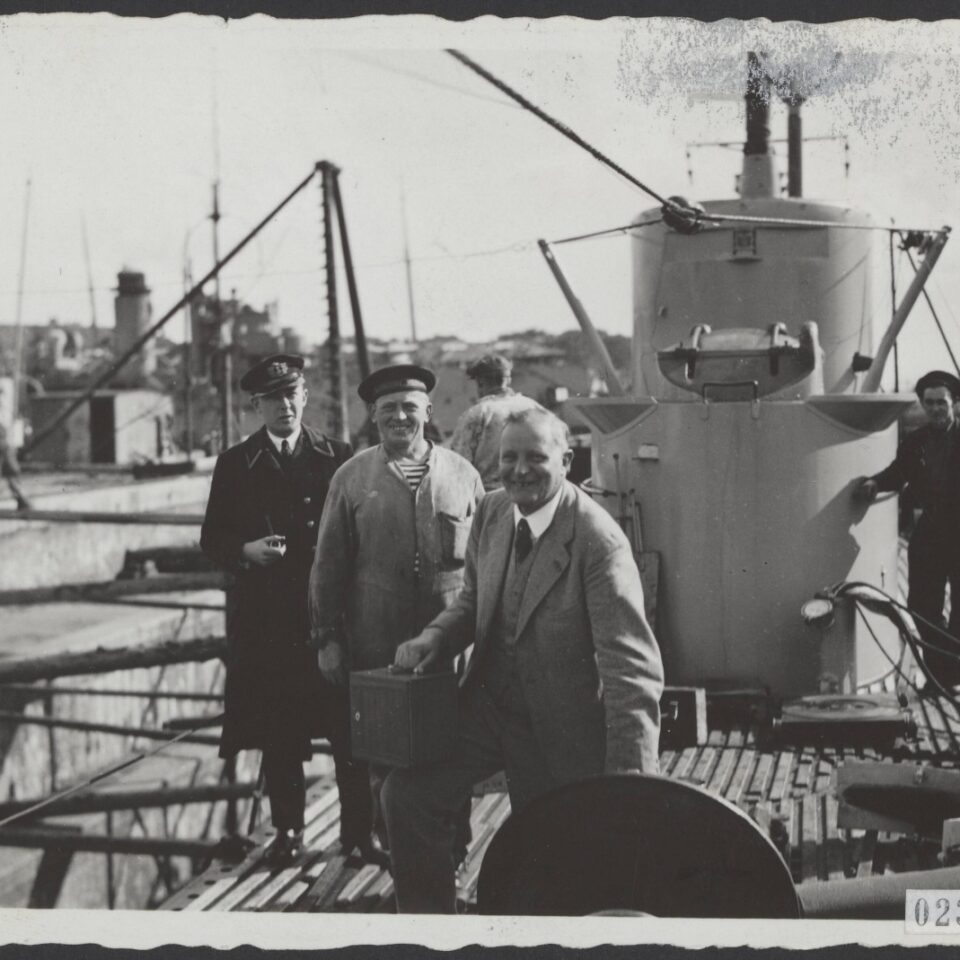


Felix Andries Vening Meinesz is a notable Dutch geologist whose research contributed primarily to the earth’s gravity measurement and the earth’s crust. Joining the Netherlands Geodetic Committee in 1910 after graduating from Technological University of Delft, he started his career by developing a suitable apparatus for research, which also helped him to obtain his doctoral degree in 1915. Once the research on the apparatus was completed, he was able to conduct several investigations on the earth’s gravity at sea across the world using a pair of pendulums on a submarine from 1923 to 1939.1 This article aims to present critical introduction of the works of Vening Meinesz by focusing on the role of local people in his expedition in colonial Indonesia. While all his expeditions are essential for geological studies, I focus on his expeditions through the Netherlands Indies carried out from 1929 to 1930 because of the mentioning of some “native crew members” on his submarine. To examine how Vening Meinesz mentions and/or omits them, I present two different sources: Gravity Expeditions at Sea Vol. I and “By Submarine Through the Netherlands East Indies”.
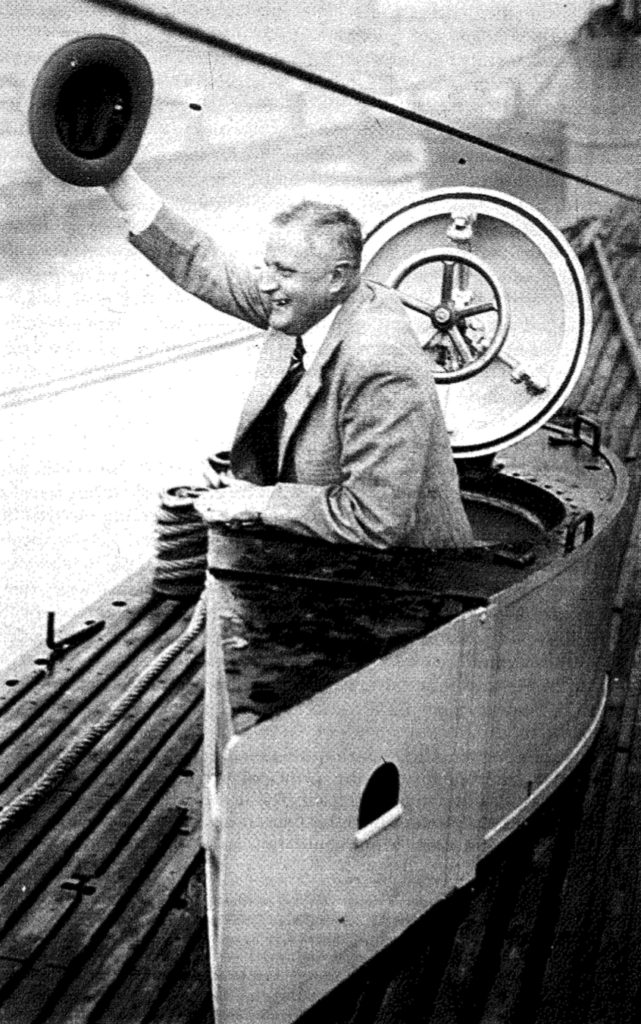
(Source: Lewis Pyenson, Empire of Reason: Exact Science in Indonesia 1840-1940. Leiden: Brill, 1988, pp. 130.)
It is quite challenging to read sources and try to find something about local helpers, especially when the nature of the research does not require a lot of help from others, like Vening Meinesz’s expeditions seems to do. However, the existence of some native men in his crew raises question about their involvement in the expedition through the Indonesian archipelago in 1929-1930. To understand this, I first read along Vening Meinesz’s book to get the picture of his research, the reason why he needs or needs not help from local people in the investigation. Following that, I move to reading against the grain by comparing his book to his travel account to find more information explicitly and implicitly about the native crew members. While he does not provide much information about them in the two sources, from the article, I found out the possible reasons of native crew members’ omission in the expedition and his general perspective on local people of Indonesian archipelago.
Two Sources of the Expedition through the Netherlands-Indies
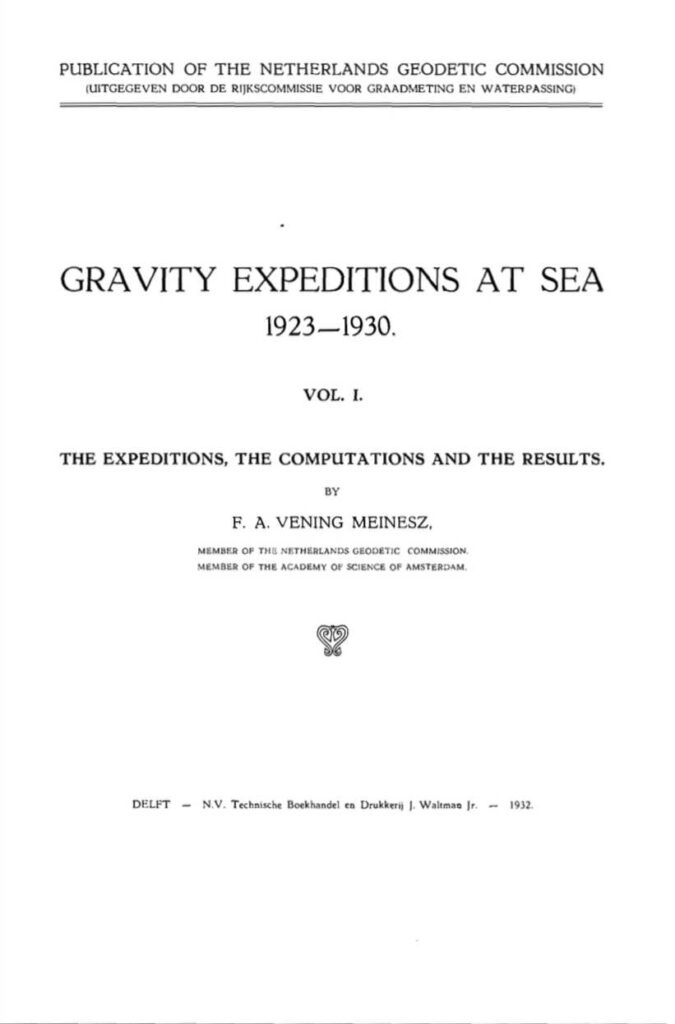
In 1932, Vening Meinesz published the report of the expeditions and the result of his investigations in a series of books entitled Gravity Expeditions at Sea, consisting of four different volumes. He describes the expeditions through the Netherlands Indies on Chapter V of the first volume of the book.2 Published under the Netherlands Geodetic Committee, these books are an official release of Vening Meinesz’s long-term research where he explains the technical process and the outcome of the examinations in formal tone. In this book, he acknowledges people contributing to the success of his research, for instance the president of the Netherlands Geodetic Committee, the Netherlands Navy, and the captains of the submarines which he boarded on, whom he mentions in the preface. The further detail of acknowledgement continues in Chapter I, where Vening Meinesz mentions the name of people who has helped him through his research in various places. However, the remark on the local helpers only appears in Chapter V when Vening Meinesz comments on the staff and crew members of Hr. Ms. K XIII, the submarine specifically employed for the expedition.
A year prior, Vening Meinesz had written a journal article about his expedition through the Netherlands Indies from 1929 to 1930, “By Submarine Through the Netherlands East Indies.”3 While the books focus on the results of the examinations on gravity at sea, the article provides the information on the journey in the Indonesian archipelago, so it can be regarded as his travel account. The article, written in a less formal style, was initially delivered at the Evening Meeting of the Society on 17 November 1930 (I suppose the Society refers to the Royal Society of London, in which he actively participated and became the foreign member in 1936).4 In this article, Vening Meinesz mentions several times about the existence of native crew members in K XIII. However, he centers the article more on the ethnographical aspects of the areas he visited rather than explaining the journey on the submarine, that affected the omission of the local helpers. Nevertheless, several aspects of Vening Meinesz perspective towards local people in Indonesian archipelago can be inferred from comparing the official books and this journal article.
Comparing the Sources on the Mentioning of Indigenous People
The voyage through the Netherlands Indies began on 12 June 1929, aimed to perform the gravimetric survey of the seas of the archipelago to obtain a detail knowledge of the seafloor, and covered nearly 16,000 miles and providing gravity data for 233 stations.5 There were three different segments of the expedition; the first voyage was traveling the eastern part of the archipelago from 12 June to 12 August 1929, the second voyage was examining Celebes (Sulawesi) from 8 October to 14 November 1929, and the last voyage was investigating Sumatra from 2 January to 15 February 1930.6
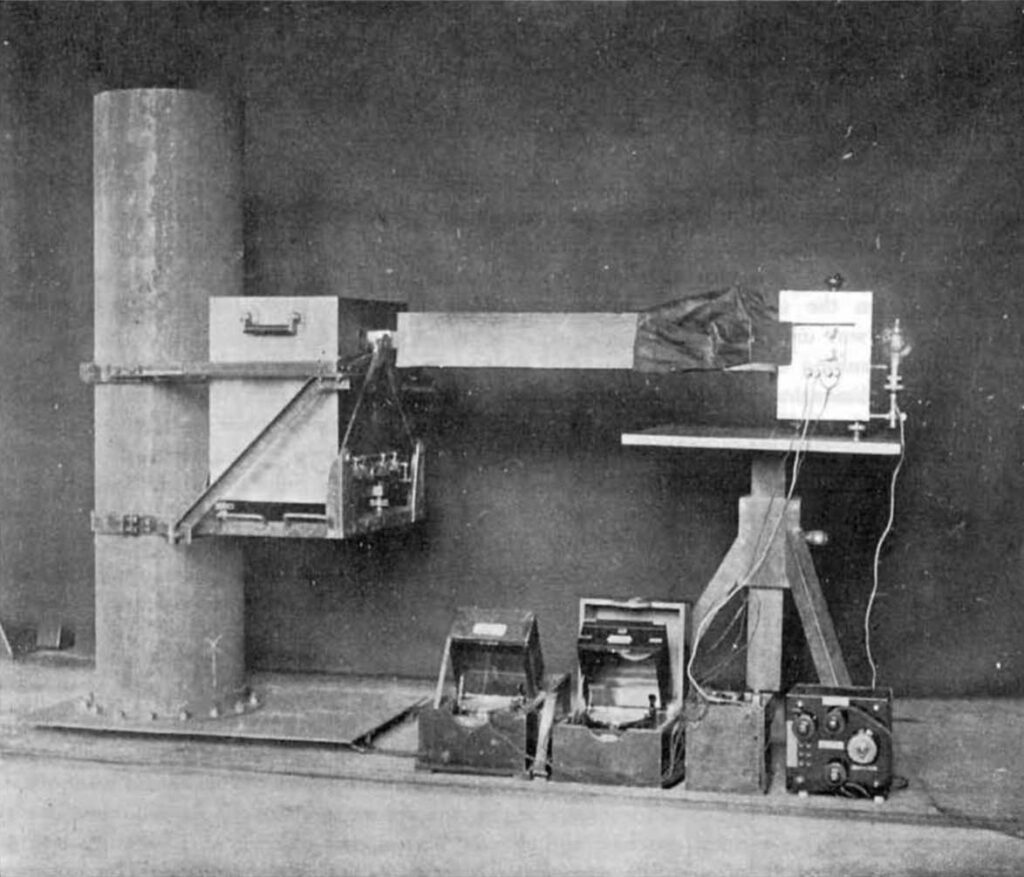
In Gravity Expeditions at Sea, Vening Meinesz always mentions the number of the submarine’s officers and crew members in the beginning of the description of all expeditions. He sometimes mentions the names of the officers, sometimes does not. However, he always states the name of the commander of the submarine and leaves out the name of the crew members. Specifically, in the expedition through the Indonesian archipelago, he notes the existence of ten native crew members.7 The remark on the local crew members never exists in other expeditions, including in the previous journey in Java and other part of the archipelago, so I assume that they were particularly recruited for this mission. Moreover, this is the one and only time he addresses local people in the book.
Different situation, although not much, is captured in his journal article where Vening Meinesz makes several remarks on local people of the places he visited as well as the native crew members of K XIII. When explaining the submarine, he mentions that there were eighteen men living in the 25-feet-long vessel, including seven native crew members. This is the first contrasting information that the number of native crew members are mentioned differently in the two sources. Nevertheless, similar with the book, there is no name of the crew mentioned in the article, except for the commander of K XIII, Lieutenant Goris Mante, who receives Vening Meinesz’s deep respect because of his helpful assistance in the difficult expedition.8 The second difference found in this article is that Vening Meinesz mention not only the number of native crew members, but also their ethnicity and gender.9 In the end of the article, he also cited a native saying in sympathetic tone, indicating that he might have treated them at the same level as other crew members, who work professionally as sailors of the Netherlands Navy’s ship.10 This fact, in addition to the nature of his research, might be the reason why Vening Meinesz omits the local crew members in his expedition because he thought that they did not contribute significantly to his work, or their contribution was so minimal that it became insignificant.
Furthermore, Vening Meinesz seems to show immense interest in the anthropological aspects of the archipelago which takes most of his description in the article. When describing people of the area he visited, Vening Meinesz realizes the variety of ethnicity in the archipelago and, therefore, makes different comments on every place he visits. However, he generally views the people as non-agentive communities who only begin to advance with the guidance of the West. He also sometimes describes the history and political situation of the places, for instance of what he comments on Bali.11 From his description, notwithstanding the fact that Vening Meinesz does not attach any references to his article, I assume that he obtains the information about the people and places from secondary sources, especially Western literatures. Not only his perspective is heavily influenced by Western knowledge and perception at that time, but his writing maintains a distance from the subject of explanation. In addition, Vening Meinesz also provided some ethnographic photographs into his article—pictures that I doubt were directly taken at the time of his voyage because there is no mention of photographer in his crew.
Conclusion
Vening Meinesz’s expeditions in the Indonesian archipelago from 1929 to 1930 primarily shows something that often undoubtedly accompanies the production of scientific knowledge: the omission of the role of indigenous people. Not only they helped scientists conduct research by being assistants, cooks, porters, etc., but they also sometimes became informants. Some researchers mention the helps, but some others purposely omit them. In Vening Meinesz’s expeditions through the archipelago, the mentioning is very limited, yet it still indicates a few of things. First, there were local sailors in the Netherlands Indies Navy who contributed, to the certain level, to the expeditions. Second, the local sailors, who only appears in the specific expeditions, might be purposely recruited. Therefore, they might provide information about the archipelago to Vening Meinesz or, at least, helped him to travel and conduct his research well through the archipelago. However, since they were supposedly sailors under the Netherlands Indies Navy, their main job was to help the captain of the submarine and, therefore, might not directly contribute to Vening Meinesz’s research–which then causing the omission of their role in the expeditions. Lastly, the focus of Vening Meinesz’s description in his journal article affected the omission of the native crew members as well. Instead of explaining why and how they were on his crew, Vening Meinesz chose to give ethnographic narratives on the people of the areas he visited throughout the journey, which I highly assume to be obtained from secondary sources.
- Bruins and Scholte, “Obituary Felix Andries Vening Meinesz, 1887-1966”, pp. 296-297 https://doi.org/10.1098/rsbm.1967.0015, accessed on 17 November 2024 ↩︎
- Vening Meinesz, Gravity Expedition at Sea Vol. I The Expedition, The Computations and The Results, Delft: N.V. Technische Boekhandel en Drukkerij J. Waltman Jr., 1932, pp. 67-99. ↩︎
- Vening Meinesz, “By Submarine Through the Netherlands East Indies”, The Geographical Journal, Vol. 77, No. 4 (Apr. 1931), pp. 338-348. ↩︎
- Bruins and Scholte, op.cit., p. 303. ↩︎
- Vening Meinesz, Gravity Expedition at Sea Vol. I, p. 9. ↩︎
- Ibid., pp. 72-80. ↩︎
- Ibid., pp. 71. ↩︎
- Vening Meinesz, “By Submarine”, p. 339. ↩︎
- Ibid., p. 343. ↩︎
- Ibid., p. 348. ↩︎
- Ibid., p. 340. ↩︎
